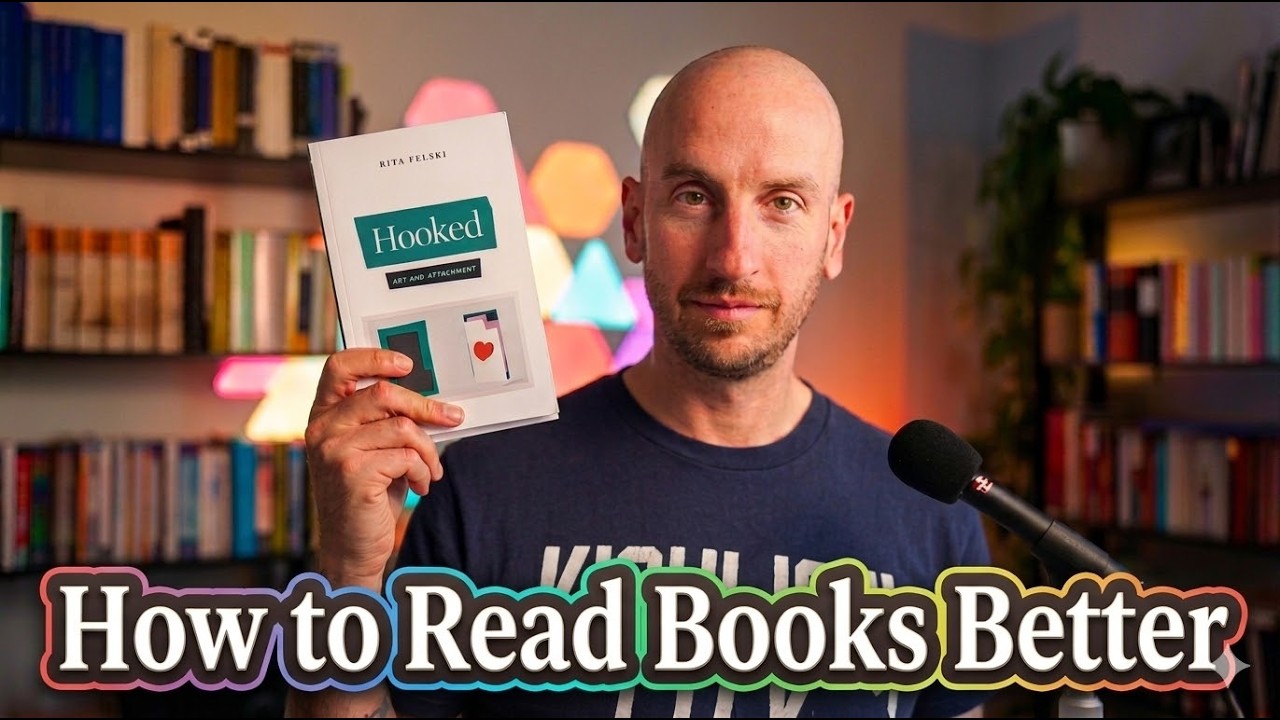
The Limits of CritiqueMarginaliaMar 8, 2026I'm starting to think that perhaps it's better for us to read actual criticism and literary theory than the books themselves. If authors are merely the curators of the experience, the popular experience that they are sharing with the world, then literary critics are the curators
Mar 9, 2026It seems that the depth of a text isn’t in the text itself but whatever the reader projects into the text. If you’re not aware of history, then the text doesn’t have that at its core. If you’re not aware of psychology, then the text isn’t hiding that either. There’s no depth to a
Mar 10, 2026It seems to me like this book is the Mimesis of criticism in which Felski is going through a long history of different critical methods and describing how they represented the culture of critics at the time the way Auerbach was talking about how fiction was representing its cultu
Mar 11, 2026One of the things that I wonder about the hermeneutics of suspicion and the literary critic as private investigator is that the investigator doesn't have a theory at first they just look at the evidence and then the evidence presents a hypothesis to them does a literary scholar a
Mar 12, 2026While authors of fiction are curators of their ideology and repackagers of their baggage, they’re the storytellers and not the bureaucrats. They don’t cite their sources, they don’t explicitly acknowledge they are a node in a vast network. They are the artistic spirit of egoic in
Mar 14, 2026Loved this book and I want to read it again.
I will look over the quotes that I’ve saved and bring them up in discussions more. Also, I will see how post-critical readings can enhance this experience on the app. How do I get readers to connect more with their works? Is this not
Quotes“Modern critics are, in Michael Walzer’s words, specialists in complaint.
Even if their argument presses forward to a final remedy, the key refrain is a blistering excoriation of society. Dissatisfaction serves as evidence of clear-sightedness; a melancholic estrangement from ordinary life, embodied most poignantly in a figure such as Adorno, is the price to be paid for this sharpened perception. Meanwhile, those unwilling to come on board with critique can be reproached for their hidebound attachments to traditional forms of life. Such attachments become newly shameful in the time-consciousness of modern thought, which looks to the future as a hoped-for deliverance from the failings of the past.”
“While the larger world is pictured as a zone of dull compulsion and coercion, the literary work is hailed by the formalist critic as a zone of radical ambiguity that promises a momentary freedom from such constraint.”
“The authority of critique is often conveyed implicitly not through propositions and theses, but via inflections of manner and mood, timbre and tone, precisely because a certain kind of normative argument no longer seems possible. It is now the posture of the critic that carries proportionate weight: ironic, reflexive, fastidious, suspicious, and implacable foe of false dualisms and foundational truths.”
“Why are we so hyper articulate about our adversaries and so excruciatingly tongue tied about our loves”
“The critic advances holding a shield, scanning the horizon for possible assailants, fearful of being tricked or taken in, locked into a cycle of punitive scrutiny and self scrutiny she cuts herself off from a swathe of intellectual and experiential possibilities.”
“My objection is not to the existence of norms as such - without which thinking could not take place - but to the relentless grip in recent years of what we could call an antinormative normativity: skepticism as dogma.”
“Critical detachment in this light is not an absence of mood, but one manifestation of it, a certain orientation towards one's subject, a way of making one's argument matter. It is tied to the cultivation of an intellectual persona that is highly prized in literary studies and beyond: Suspicion, knowing, self-conscious, hardheaded, tirelessly vigilant.”
“Yet “suspicion” is not a term around which scholars have been eager to rally, worrying, no doubt, that any inference to motive or mind-set will undercut their authority. There is an understandable wariness of being tarred with the brush of subjective or emotional response. To gauge the affective tone of scholarship, however, is not to spurn its substance but to face up to the obvious: modes of thought are also orientations toward the world that are infused with a certain attitude or disposition; arguments are a matter not only of content but also of style and tone.”
“We think of the act of reading as involving a chasm of distance or a huddled proximity: we gaze up at the literary work in reverence or look down on it in caustic condemnation; we think of our analytical tools as probing deep into a text’s crevices or striking against its glassy, unyielding surface. Such images sum up how a critic conceives the task of interpretation, creating a certain view of the relations between reader, text, and world. These spatial metaphors, however, convey not only ideas but also subliminal surges of attachment or disengagement, intimacy or estrangement. They prime us to adopt certain attitudes, so that we open the pages of a book already caught up in an anticipatory state of irritation or hope, empathy or skepticism.”
“Fresh metaphors spin connections that startle us into new ways of seeing; worn-out metaphors slow down our mental software, rendering it sluggish and stale. Figures of speech can become stubbornly entrenched and hard to budge, taking on a life of their own, dictating what and how we see. As a result, we are held hostage by our own pictures, configured by the force of our own figures.”
“The idea of critique, we could say, contains the answer to its own question: as a highly normative concept, it knows itself to be exceptional, embattled, oppositional, and radical. Whatever is not critique, by contrast, must fall into the camp of the credulous, compliant, and co-opted. In short, critique requires its antithesis in order to shore up its own virtues: the foil of a crushing system of domination or subjugation that turns out, nonetheless, to be strangely vulnerable to the threat of verbal exposure.”
“the dandy’s immaculate self-consciousness and disdain for sentimental effusions is perfectly attuned to the scholarly zeitgeist, allowing the critic to carve out a skeptical distance from the mainstream without lapsing back into an earnest language of reason and truth or an old-school worship of art.”
“The idea of human nature comes under withering scrutiny from critics implacably opposed to universals, assailed with special vigor by feminist, queer, and antiracist critics conscious of its many historical uses in sanctioning social inequality. The notion of an inner nature , of a fateful inner self and personal calling, is viewed as a naïve Romantic holdover or a nakedly ideological belief in the autonomy and supremacy of the individual. What we think is inside is really outside: our sense of an inner reality is manufactured by external forces,”
“Stories, critics charge, strive to simplify and shortchange a world of infinite possibility; they ride roughshod over the complexity of phenomena; they impose schemata that push characters down predetermined paths and block other options from view. Narrative, in short, has been hailed as a mechanism of cultural coercion, one of the ways in which readers are inveigled into certain ways of acting and thinking.”
“Accountability brings us to matters of cause and effect; we can only be held responsible for events if we play some part in making these events happen. To put it another way, guilt is inseparable from narrative. The critic, like the detective, must tell a persuasive story: both slot events into a chronological sequence, track down agents engaged in wrongdoing, and parcel out blame. In both cases, pinning down wrongdoing is a matter of establishing means, motive, and opportunity. Suspicious readings, in short, are forms of plotting that seek to identify causes and assign guilt.”
“this fictional status of personhood is hidden from sight, notes Butler, thanks to a stubborn attachment to Romantic notions of interiority and an unwillingness to relinquish a sense of our own uniqueness. The truth of superficiality, in other words, is a truth that is hard to access and concealed from view, buried under the sediment of everyday beliefs.”
“It was already apparent that categories like “woman” or “gay” were less unified and cohesive than they appeared, and that those who belonged to subordinate groups were quite capable, in their turn, of manipulating or marginalizing others—in short, that the world did not divide cleanly into camps of oppressors and victims, the powerful and the powerless.”
“All too often, remarks Latour to intellectuals—he's speaking of sociologists, but the point holds more generally—behave as if they were critical, reflexive, and distanced inquirers, meeting a naïve, uncritical, and unreflexive actor. Critical thinking is restrained to one side of the intellectual encounter, and lay thought is pictured as a zone of undifferentiated doxa.”
“You do not know that you are ideologically driven, historically determined, or culturally constructed,” declares the subject of critique to the object of critique, “but I do!”
“Yet the negativity of critique, like Baskin-Robbins ice cream, also comes in various flavors; it is not just a matter of fault-finding, scolding, censuring, and correcting. Indeed, quite a few scholars are eager to back away from the rhetoric of denunciation, a posture short on stylistic subtlety as well as philosophical nuance. The nay-saying critic all too easily brings to mind the finger-wagging moralist, the thin-lipped schoolmarm, the Victorian patriarch, the glaring policeman. The act of negating is tangled up with a long history of prohibition and interdiction and burdened with a host of unattractive associations. It can all too easily come across as contemptuous, vengeful, heartless, or vitriolic. In recent years, it has often been tied up with stereotypes of killjoy feminists, embittered minorities, and other resentment-filled avatars of “political correctness””
“Like an upscale detox facility, critique promises to flush out the noxious substances and cultural toxins that hold us in their thrall. It demonstrates, again and again, that what might look like hopeful signs of social progress harbor more disturbing implications. In this sense, there is a logic of perfectionism or absolutism at work: not just impatience with the slowness of incremental change but a conviction that such change is actively harmful in blinding us to what remains undone. Disguising a failure to root out structural inequality, it only promotes complacency and shores up the forces of liberal optimism.”
“of critique, declare Janet Halley and Wendy Brown, is to “dissect our most established maxims and shibboleths.” According to Robert Davis and Ronald Schleifer, critique “terrorizes received ideas” and is “ always questioning culture.” Who would not want to be seen as dissecting shibboleths? Is it not the fundamental job of intellectuals to question culture? And why would anyone want to be associated with the bad smell of the uncritical? Critique, it must be said, is gifted with an exceptionally talented press agent and an unparalleled mastery of public relations. Occupying the political and moral high ground in the humanities, it seems impervious to direct attack, its bulletproof vest deflecting all bursts of enemy fire. Indeed, as we’ll see, even those most eager to throw a spanner into the machinery of critique—those gritting their teeth at its sheer predictability—seem powerless to bring it to a halt. The panacea they commonly prescribe, a critique of critique, might give us pause. How exactly do we quash critique by redoubling it? Shouldn’t we be trying to exercise our critique-muscle less rather than more?”
“We cannot afford to be quite so cavalier about the differences between finding things out and making them up, between imposing our ideas on a text and learning something from a text.”
“Critique first sniffs out the guilt of others, only to engage, finally, in an anguished flurry of breast-beating and self-incrimination, a relentless rooting out of concealed motives and impure thoughts. Mea culpa, mea culpa, mea maxima culpa—except that, in contrast to Christian theology, there is no hope of final salvation!”
“his wake, various critics have brooded over the inevitable guilt of reading, calling for a scrupulous inventory of one’s own interpretative sins. But why, we might wonder, must reading always be a matter of guilt and innocence, crime and complicity? Such wording suggests a secular spin on Christian doctrine: we are all stained by the original sin of interpretation.”
“instigated a heightened sensitivity about the power-laden language of interpretation: a rueful realization that suspicious reading was imputing the very signs of guilt it claimed to discover. In response, various critics rallied to literature’s defense, eager to establish its innocence and clear its name, to protect it from appropriation and to safeguard it from the accusations of overzealous interpreters. While the literary work is exonerated and granted immunity from prosecution, it is now criticism itself that becomes the crime”
“In consequence, other ways of reading are presumed, without further ado, to be sappy and starry-eyed, compliant and complacent. A substantial tradition of modern thought that has circumvented or challenged the logic of critique—ranging from the work of Wittgenstein, Cavell, and Polanyi to more recent avatars such as Latour and Rancière—drops out of sight. We are led to believe that the only alternative to critique is a full-scale surrender to sentimentality, quietism, Panglossian optimism, or—in literary studies—the intellectual fluff of aesthetic appreciation. In short, critique stacks the cards so that it always wins.”
“We cannot simply oppose interpretation and use, Macé argues, as if we could somehow arrive at a way of engaging with the literary work that is scrubbed clean of our mundane needs, desires, and interests. This is the dream of transcendence, of reading and writing from nowhere, of engagement without the original sin of appropriation, that literary critics are often reluctant to relinquish.”
“what of those moments when the impact of a text is unforeseen, when it impinges on us in ways we cannot predict or prepare for? What about the song on the radio that unexpectedly reduces you to tears, the horror movie gore-fest that continues to haunt your dreams, the novel that convinced you to take up Buddhism or to get divorced? For Bennett, as for Stanley Fish, a literary work seems to be a blank screen on which groups of readers project their preexisting ideas and beliefs. We are thus hard-pressed to explain why any text should matter more than any other, why we can register the differences between individual texts so strongly, or how we can be aroused, disturbed, surprised, or brought to act in ways that we did not expect and may find it hard to explain. As Bennett himself acknowledges, the context of the reading formation trumps and transcends the power of the text.”

 €100K
€100K Thousands
 3 continents
 #9
#9